
GHRP-6 Acetate Research Peptide (Growth Hormone Releasing Peptide-6)
Lyophilized Format • ≥99% HPLC Purity • Ships in 1–2 Business Days • U.S. Warehouses
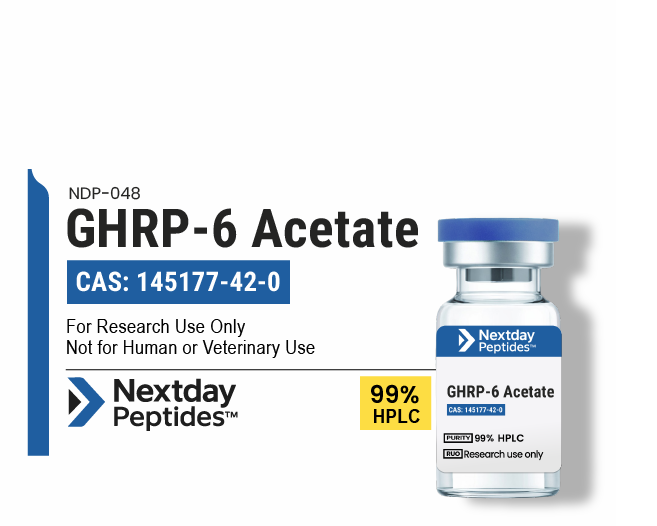
GHRP-6 Acetate (Growth Hormone Releasing Peptide-6, SKF-110679, CAS 145177-42-0) is a synthetic hexapeptide with the sequence His-D-Trp-Ala-Trp-D-Phe-Lys-NH₂ and one of the original first-generation growth hormone secretagogues developed through systematic met-enkephalin analog research, supplied by Nextday Peptides in lyophilized acetate salt format for laboratory and analytical research applications. As the foundational reference GHRP against which all subsequent GHRPs and GHS-R1a agonists — including GHRP-2, Ipamorelin, and Hexarelin — have been pharmacologically characterized, GHRP-6 holds a unique position as the historical anchor compound for GHS-R1a receptor biology research. For scientific research use only.
Compound Specifications
| Compound Name | GHRP-6 Acetate / Growth Hormone Releasing Peptide-6 / SKF-110679 |
| Peptide Sequence | His-D-Trp-Ala-Trp-D-Phe-Lys-NH₂ |
| Amino Acids | 6 (Hexapeptide) |
| Salt Form | Triacetate salt |
| Receptor Target | GHS-R1a (Ghrelin Receptor) — Ki 1.9 nM at human GHS-R1a (reference data) |
| Signaling | Gq/11 → PLC → IP3/DAG → Ca²⁺ mobilization (EC50 4.5 nM in BHK cells) |
| Molecular Formula | C₄₆H₅₆N₁₂O₆ · 3C₂H₄O₂ |
| Molecular Weight | 873.01 g/mol (free base) / 1053.2 g/mol (triacetate) |
| CAS Number | 145177-42-0 (triacetate salt) |
| Form | Lyophilized powder (triacetate salt) |
| Appearance | White to off-white powder |
| Purity | ≥99% (HPLC verified) |
| Solubility | Water, acetic acid, DMSO |
| Storage | -20°C lyophilized; 2–8°C after reconstitution |
| Synonyms | SKF-110679, U-75799E, Hexapeptide-2, HWAWFK-NH₂, Growth Hormone Releasing Hexapeptide |
Why Research Laboratories Select GHRP-6
GHRP-6 is the original synthetic GHS-R1a agonist — the first-generation GHRP against which all subsequent GHRPs are characterized in comparative pharmacology research. Its well-documented GHS-R1a binding profile (Ki 1.9 nM), calcium mobilization EC50 (4.5 nM), and inositol phosphate production EC50 (0.83 nM) from published Cayman Chemical reference data make it the standard baseline compound for GHS-R1a receptor pharmacology research. Uniquely among GHRPs, GHRP-6 also acts as a negative allosteric modulator of ghrelin signaling — a property not shared by Ipamorelin or Hexarelin — making it an irreplaceable pharmacological tool for studying GHS-R1a receptor modulation dynamics.
- First-generation synthetic GHRP — foundational reference compound for all GHS-R1a receptor pharmacology research
- Well-characterized binding profile — Ki 1.9 nM at human GHS-R1a from published reference data
- Negative allosteric modulator of ghrelin signaling — unique property not shared by Ipamorelin or Hexarelin
- Selective GH release — induces GH but not TSH, LH, FSH, or prolactin in isolated rat pituitary research models
- Ghrelin mimetic — significant ghrelin pathway activity studied in appetite regulation and gastric motility research models
- Reference compound for structure-activity relationship studies — GHRP-2, Ipamorelin, Hexarelin all derived/compared from GHRP-6 baseline
- Triacetate salt form — consistent with Cayman Chemical pharmaceutical reference standard
- Batch and lot identifiers on all labeling for full laboratory documentation compliance
Research Background
GHRP-6 was developed by Bowers et al. at Tulane University in the early 1980s through systematic structure-activity relationship studies on met-enkephalin analogs. Bowers et al. (1984) published the initial characterization in Endocrinology. Howard et al. (1996) published landmark findings on the GHS-R receptor cloning in Science — establishing that GHRP-6 and related GHRPs activate a distinct receptor later identified as the ghrelin receptor (GHS-R1a). Korbonits et al. and multiple other groups published comparative GHRP pharmacology data throughout the 1990s and 2000s. GHRP-6 remains the standard reference compound in GHS-R1a pharmacology research. All information provided here is for educational and reference purposes only and does not constitute medical or clinical guidance.
Reference sources: PubChem — GHRP-6 | Howard et al. (1996) — Science (GHS-R cloning)
Shipping & Fulfillment
- Ships from U.S. warehouses — Florida, North Carolina, and California
- Overnight and 2-day shipping available at checkout
- Same-day processing on orders placed before 3:30 PM ET
- Discreet packaging with full tracking provided
- Bulk research orders welcome — contact us for volume pricing
Storage & Handling
- Store lyophilized peptide at -20°C away from light and moisture
- After reconstitution store at 2–8°C and use within 14 days
- Avoid repeated freeze-thaw cycles to maintain peptide integrity
- Handle using appropriate laboratory safety protocols
- Keep containers sealed when not in use
GHRP-6 vs GHRP-2 in Pharmacology Research
GHRP-6 and GHRP-2 are both first-generation synthetic hexapeptide GHS-R1a agonists derived from the same met-enkephalin analog lineage, yet they occupy distinct roles in comparative pharmacology research. GHRP-6 (His-D-Trp-Ala-Trp-D-Phe-Lys-NH₂) retains the original Bowers et al. sequence and serves as the historical baseline reference compound. GHRP-2 substitutes D-Ala at position 2 for D-Trp, yielding a structurally related analog frequently used alongside GHRP-6 in structure-activity relationship and receptor-binding studies. Published reference data characterize GHRP-6 with Ki 1.9 nM at human GHS-R1a and unique negative allosteric modulation of ghrelin signaling — properties not shared by GHRP-2, Ipamorelin, or Hexarelin. Laboratories running side-by-side GHS-R1a assays often pair GHRP-6 as the foundational comparator with GHRP-2 to evaluate how single-residue modifications alter receptor engagement, signaling kinetics, and ghrelin pathway cross-talk in controlled in-vitro systems. All compounds discussed here are supplied strictly for scientific, analytical, and laboratory research use only.
Frequently Asked Questions
What is GHRP-6 Acetate?
GHRP-6 Acetate (Growth Hormone Releasing Peptide-6, CAS 145177-42-0) is a synthetic hexapeptide with the sequence His-D-Trp-Ala-Trp-D-Phe-Lys-NH₂. Developed by Bowers et al. in the early 1980s, it is the original first-generation GHS-R1a agonist and foundational reference compound for GHS-R1a receptor pharmacology research. Supplied strictly for scientific, analytical, and in-vitro laboratory research use only.
How does GHRP-6 differ from Ipamorelin?
Both are synthetic GHS-R1a agonists but with distinct pharmacological profiles. GHRP-6 is a first-generation hexapeptide with broader ghrelin mimetic activity — notably stimulating appetite and gastric motility through ghrelin pathway activation — and acts as a negative allosteric modulator of ghrelin signaling. Ipamorelin is a second-generation pentapeptide engineered for high GHS-R1a selectivity and minimal cross-reactivity with other pituitary pathways. GHRP-6 is used as the foundational reference; Ipamorelin for selectivity-focused research.
How does GHRP-6 differ from Hexarelin?
Hexarelin incorporates a D-2-methyltryptophan at position 2 versus GHRP-6’s standard D-tryptophan — providing approximately 30-fold greater GHS-R1a binding affinity and additional GHS-R1a-independent cardiac receptor binding activity. GHRP-6 is the baseline reference compound; Hexarelin is used when higher potency or cardiac receptor engagement is required in research models.
What makes GHRP-6 unique among GHRPs?
GHRP-6 is the only common synthetic GHRP that simultaneously acts as a GHS-R1a agonist and a negative allosteric modulator of endogenous ghrelin signaling at the same receptor. This dual pharmacological property makes it uniquely useful for dissecting the GHS-R1a receptor modulation landscape in experimental systems.
What purity is your GHRP-6 Acetate?
Every batch is independently verified to ≥99% HPLC purity. A Certificate of Analysis is available for each lot.
How fast does Nextday Peptides ship?
We ship from U.S. warehouses in Florida, North Carolina, and California. Overnight and 2-day shipping options are available. Orders placed before 3:30 PM ET are processed same day.
Are bulk orders available?
Yes. We accommodate bulk research orders. Contact us directly for volume pricing and availability.
Is this product approved for medical use?
No. This product is for laboratory research use only. It is not approved for human or veterinary use, and is not intended for diagnostic, therapeutic, or clinical applications.
What other compounds does Nextday Peptides carry?
We also carry Ipamorelin, Hexarelin Acetate, Sermorelin, and CJC-1295 No DAC. View our full research compounds catalog.
How does GHRP-6 differ from GHRP-2?
Both are first-generation synthetic GHS-R1a agonists, but GHRP-6 (His-D-Trp-Ala-Trp-D-Phe-Lys-NH₂) is the original reference hexapeptide against which GHRP-2 and later GHRPs are characterized. GHRP-2 carries a D-Ala substitution at position 2 instead of D-Trp, producing a related analog used in comparative binding and signaling assays. GHRP-6 uniquely acts as a negative allosteric modulator of ghrelin signaling at GHS-R1a and exhibits broader ghrelin mimetic activity in published research models — including appetite and gastric motility endpoints studied for receptor pharmacology. GHRP-2 is typically selected when researchers need a closely related structural analog for side-by-side potency or selectivity comparisons. Neither compound is intended for human or veterinary use.
What research applications is GHRP-6 Acetate used for?
In laboratory and in-vitro research, GHRP-6 Acetate is used as the foundational GHS-R1a reference compound for receptor pharmacology, calcium mobilization assays, and inositol phosphate production studies. Its well-documented binding profile (Ki 1.9 nM at human GHS-R1a) and signaling data (EC50 4.5 nM for Ca²⁺ mobilization in BHK cells) make it a standard baseline in structure-activity relationship work comparing GHRP-2, Ipamorelin, and Hexarelin. Researchers also employ GHRP-6 to study ghrelin receptor modulation dynamics, pituitary GH release in isolated rat models, and ghrelin pathway activity in appetite and gastric motility experimental systems. All applications are limited to controlled scientific research — not clinical, diagnostic, or therapeutic use.
What effects are documented in preclinical GHRP-6 research models?
Published preclinical and in-vitro research on GHRP-6 has documented GHS-R1a-mediated growth hormone release in isolated rat pituitary models without concurrent TSH, LH, FSH, or prolactin elevation. Investigators have also reported ghrelin mimetic activity — including appetite stimulation and gastric motility changes — when studying ghrelin pathway signaling. These observations arise from controlled experimental systems used to map receptor pharmacology, not from human clinical data. GHRP-6 Acetate from Nextday Peptides is supplied exclusively for laboratory research; it is not approved for human or veterinary use and must not be interpreted as safety or efficacy guidance for any living organism.
What GHRP-6 benefits are studied in laboratory research?
In controlled in-vitro and preclinical research models, investigators examine GHRP-6-mediated GHS-R1a activation, growth hormone release in isolated pituitary systems, calcium mobilization, inositol phosphate production, ghrelin pathway cross-talk, and negative allosteric modulation of ghrelin signaling at GHS-R1a. These documented research endpoints — not clinical outcomes — establish GHRP-6 as the foundational reference compound for comparative pharmacology alongside GHRP-2, Ipamorelin, and Hexarelin. GHRP-6 Acetate from Nextday Peptides is supplied strictly for scientific and analytical laboratory research use only.
How can research laboratories order GHRP-6 Acetate?
GHRP-6 Acetate is available for order directly from this product page for qualified laboratory and institutional research buyers. Each lot is verified to ≥99% HPLC purity with an accompanying Certificate of Analysis. Orders ship from U.S. warehouses with same-day processing on orders placed before 3:30 PM ET. Bulk research quantities are available on request. For research use only — not for human or veterinary use.
For Research Use Only — Not for human or veterinary consumption • Not evaluated by the FDA • Supplied by Nextday Peptides for controlled in-vitro laboratory research use only