
Thymalin Research Peptide (Thymulin / Serum Thymic Factor)
Lyophilized Format • ≥99% HPLC Purity • Ships in 1–2 Business Days • U.S. Warehouses
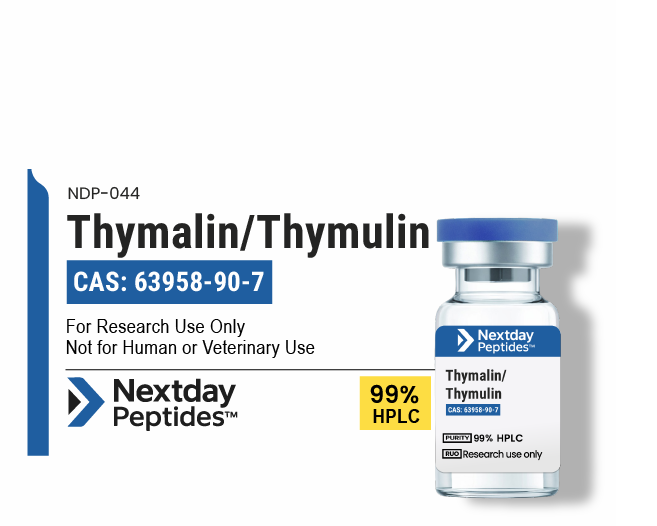
Thymalin (Thymulin, Facteur Thymique Sérique, FTS, CAS 63958-90-7) is a naturally occurring zinc-dependent nonapeptide hormone exclusively secreted by thymic epithelial cells, first discovered by Jean-François Bach’s group in Paris in 1977, supplied by Nextday Peptides in synthetic lyophilized format for laboratory and analytical research applications. With the sequence Pyr-Ala-Lys-Ser-Gln-Gly-Gly-Ser-Asn, Thymulin is the only thymic hormone whose primary structure has been fully defined — and the only endogenous thymic peptide that requires stoichiometric zinc(II) binding for biological activity, making it a uniquely zinc-dependent research tool for laboratories studying thymic T-cell differentiation pathways, zinc-metallopeptide biology, and neuroimmune signaling dynamics. For scientific research use only.
Compound Specifications
| Compound Name | Thymalin / Thymulin / Serum Thymic Factor (FTS) / Facteur Thymique Sérique |
| Peptide Sequence | Pyr-Ala-Lys-Ser-Gln-Gly-Gly-Ser-Asn |
| Amino Acids | 9 (Nonapeptide) — N-terminal pyroglutamate |
| Origin | Naturally occurring — secreted exclusively by thymic epithelial cells |
| Metal Dependency | Zinc(II) — stoichiometric Zn²⁺ binding required for biological activity |
| Molecular Formula | C₃₃H₅₄N₁₂O₁₅ |
| Molecular Weight | 858.86 g/mol |
| PubChem CID | 3085284 |
| CAS Number | 63958-90-7 |
| Form | Lyophilized powder |
| Appearance | White to off-white powder (hygroscopic) |
| Purity | ≥99% (HPLC verified) |
| Storage | -20°C desiccated lyophilized; 2–8°C after reconstitution (use within 7 days) |
| Synonyms | Thymulin, FTS, Facteur Thymique Sérique, Serum Thymic Factor, Nonathymulin |
Why Research Laboratories Select Thymalin (Thymulin)
Thymulin is the only endogenous thymic hormone whose primary amino acid sequence has been fully chemically defined — making it uniquely amenable to synthetic production for controlled laboratory research. Its absolute requirement for stoichiometric zinc(II) binding for biological activity provides a molecular switch that researchers can control experimentally — active Zn-Thymulin complex versus inactive apo-Thymulin — enabling precise investigation of zinc-metallopeptide biology, zinc-dependent T-cell differentiation signaling, and thymic immunoregulatory pathway dynamics.
- Only fully chemically defined endogenous thymic hormone — single 9 amino acid sequence with N-terminal pyroglutamate
- Zinc-dependent metallopeptide — stoichiometric Zn²⁺ binding absolutely required for biological activity in experimental models
- Studied in T-cell differentiation research — thymocyte maturation, T-lymphocyte subset development, and thymopoiesis research models
- Serum thymulin levels decline with age and zinc deficiency in published preclinical research — studied in immunosenescence models
- Studied in neuroimmune signaling — NK cell cytotoxicity, prolactin receptor interactions, and pain pathway research models
- Studied alongside Thymosin Alpha-1 and Thymopentin in comparative thymic peptide pharmacology research
- Discovered by Jean-François Bach (1977) — over four decades of published thymic immunology research literature
- Lyophilized format ensures stability and reproducibility across experimental runs
Research Background
Thymulin (FTS) was first discovered by Jean-François Bach’s group in Paris in 1977, initially described as a serum thymic factor. Bach et al. (1977) published the initial characterization in the Annals of the New York Academy of Sciences. Dardenne et al. published the complete amino acid sequence in 1982. Subsequent research from multiple groups has examined thymulin’s zinc-dependent activity switch, its role in T-cell differentiation in thymocyte culture models, its age-related serum concentration decline, and its neuroimmune signaling properties including interactions with the hypothalamic-pituitary axis. All information provided here is for educational and reference purposes only and does not constitute medical or clinical guidance.
Reference sources: PubChem — Thymulin (CID 3085284) | Dardenne et al. (1982) — Thymulin Sequence Characterization
Shipping & Fulfillment
- Ships from U.S. warehouses — Florida, North Carolina, and California
- Overnight and 2-day shipping available at checkout
- Same-day processing on orders placed before 3:30 PM ET
- Discreet packaging with full tracking provided
- Bulk research orders welcome — contact us for volume pricing
Storage & Handling
- Store lyophilized peptide desiccated at -20°C away from light and moisture — compound is hygroscopic
- After reconstitution store at 2–8°C and use within 7 days
- For long-term reconstituted storage add carrier protein (0.1% HSA or BSA) and store at -20°C
- Reconstitute in sterile 18MΩ water at ≥100 µg/mL — avoid vigorous agitation
- Avoid repeated freeze-thaw cycles to maintain peptide integrity
- Handle using appropriate laboratory safety protocols
Frequently Asked Questions
What is Thymalin (Thymulin)?
Thymalin (Thymulin, CAS 63958-90-7) is a naturally occurring zinc-dependent nonapeptide hormone exclusively secreted by thymic epithelial cells, first discovered by Jean-François Bach in 1977. Its sequence is Pyr-Ala-Lys-Ser-Gln-Gly-Gly-Ser-Asn. It is the only fully chemically defined endogenous thymic hormone and requires stoichiometric Zn²⁺ binding for biological activity. Supplied strictly for scientific, analytical, and in-vitro laboratory research use only.
Why does Thymulin require zinc for biological activity?
Thymulin (apo-Thymulin) is biologically inactive without zinc. Zn²⁺ coordinates with specific residues in the peptide chain to form the Zn-Thymulin complex — the biologically active form. Without adequate zinc the peptide adopts a conformation that cannot engage its target receptors on T-lymphocytes. This zinc-dependency provides researchers with an experimentally controllable molecular activity switch unique among thymic peptides.
How does Thymulin differ from Thymosin Alpha-1 and Thymopentin?
Thymulin (9 AA, zinc-dependent) is exclusively secreted by thymic epithelial cells and is the only fully sequence-defined endogenous thymic hormone. Thymosin Alpha-1 (28 AA, not zinc-dependent) is derived from prothymosin-α and studied for TLR2/TLR9 dual activation. Thymopentin (5 AA, not zinc-dependent) is a pentapeptide fragment of thymopoietin. All three originate from thymic biology but have completely different sequences, molecular targets, and research applications.
Why do serum thymulin levels decline with age?
Published preclinical research has established that thymulin secretion by thymic epithelial cells declines progressively with thymic involution — the age-related reduction in functional thymic mass. Zinc deficiency, which is common in aged experimental animal models, further reduces the proportion of active Zn-Thymulin complex even when total thymulin peptide is present. Both thymic involution and zinc status are studied as research variables in thymulin immunosenescence models.
What purity is your Thymalin?
Every batch is independently verified to ≥99% HPLC purity. A Certificate of Analysis is available for each lot.
How fast does Nextday Peptides ship?
We ship from U.S. warehouses in Florida, North Carolina, and California. Overnight and 2-day shipping options are available. Orders placed before 3:30 PM ET are processed same day.
Are bulk orders available?
Yes. We accommodate bulk research orders. Contact us directly for volume pricing and availability.
Is this product approved for medical use?
No. This product is for laboratory research use only. It is not approved for human or veterinary use, and is not intended for diagnostic, therapeutic, or clinical applications.
What other compounds does Nextday Peptides carry?
We also carry Thymosin Alpha-1, LL-37, BPC-157, and MOTS-C. View our full research compounds catalog.
For Research Use Only — Not for human or veterinary consumption • Not evaluated by the FDA • Supplied by Nextday Peptides for controlled in-vitro laboratory research use only