
SS-31 Research Peptide (Elamipretide / MTP-131)
Lyophilized Format • ≥99% HPLC Purity • COA Available • Ships in 1–2 Business Days • U.S. Warehouses
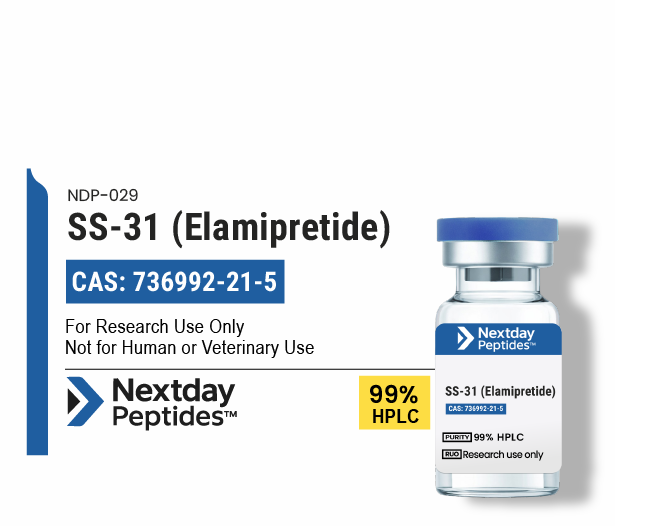
SS-31 (Elamipretide, MTP-131, Bendavia, CAS 736992-21-5) is a synthetic tetrapeptide (D-Arg-Dmt-Lys-Phe-NH₂) supplied by Nextday Peptides as an elamipretide research compound and SS-31 research peptide for laboratory and analytical applications. This mitochondrial peptide research standard is used in in-vitro models examining inner mitochondrial membrane biology, cardiolipin interaction, and oxidative stress pathways. Each lot is verified to ≥99% HPLC purity with COA documentation available. For scientific research use only — not for human or veterinary consumption. See our Research Use Only policy.
SS-31 (Elamipretide) — Mitochondrial Research Compound
SS-31 belongs to the Szeto-Schiller (SS) peptide family and is studied for selective association with cardiolipin in inner mitochondrial membrane research models. Laboratories evaluating SS-31 MTP-131 research applications typically use lyophilized material for cell-culture and analytical assays under institutional RUO guidelines — not for clinical, diagnostic, or compounding use. Research-grade material supplied here is not equivalent to any approved pharmaceutical elamipretide formulation.
Compound Specifications
| Compound Name | SS-31 / Elamipretide / MTP-131 / Bendavia |
| Peptide Sequence | D-Arg-Dmt-Lys-Phe-NH₂ (Dmt = 2′,6′-dimethyltyrosine) |
| Classification | Szeto-Schiller (SS) peptide — inner mitochondrial membrane research tool |
| Primary Research Target | Cardiolipin — inner mitochondrial membrane phospholipid |
| Molecular Formula | C₃₂H₄₉N₉O₅ |
| Molecular Weight | 639.8 g/mol |
| PubChem CID | 11764719 |
| CAS Number | 736992-21-5 |
| Form | Lyophilized powder |
| Purity | ≥99% (HPLC verified) |
| Storage | -20°C lyophilized; 2–8°C after reconstitution |
| Synonyms | Elamipretide, MTP-131, Bendavia, SS-31 peptide |
Certificate of Analysis & HPLC Verification
Batch purity is verified by HPLC at ≥99%. SS-31 COA documentation is available through our COA Library. For help interpreting purity reports, see how to read a Certificate of Analysis for research peptides.
Mechanism & Research Applications
In published preclinical literature, SS-31 is described as concentrating at the inner mitochondrial membrane in models where cardiolipin is studied as a structural and functional component of oxidative phosphorylation complexes. Research applications commonly cited include:
- Cardiolipin biology and inner mitochondrial membrane architecture studies
- Electron transport chain supercomplex organization in research models
- Oxidative stress and ROS pathway investigations (including Dmt-mediated scavenging models)
- Comparative mitochondrial pathway research alongside other reference compounds
- Cell-culture and in-vitro bioenergetics assay development
Why Research Laboratories Select SS-31
SS-31 is widely referenced in peer-reviewed mitochondrial research because of its defined tetrapeptide structure, cardiolipin-focused mechanism of association in model systems, and extensive published literature base. For structured laboratory comparisons, SS-31 is frequently evaluated alongside complementary mitochondrial research materials.
- Defined SS-family tetrapeptide sequence for reproducible assay design
- Cardiolipin-associated inner membrane research model cited in primary literature
- Lyophilized format supports stable storage and batch-to-batch consistency
- Documented ≥99% HPLC purity with COA traceability
- Useful in side-by-side studies with MOTS-c (mitochondrial-derived peptide signaling models) and NAD+ (redox/cofactor research)
SS-31 vs. MOTS-c vs. NAD+ (Research Comparison)
| Compound | Research Role (Literature) |
| SS-31 (Elamipretide) | Membrane-associated SS peptide studied in cardiolipin / inner membrane models |
| MOTS-c | Mitochondria-derived peptide studied in metabolic signaling research models |
| NAD+ | Cofactor studied in redox balance and cellular energetics research |
Comparison provided for laboratory reference only. All materials are supplied for in-vitro research use only.
Research Background (Literature Reference)
SS-31 / elamipretide has been discussed extensively in scientific literature regarding mitochondrial membrane biology. Published reviews and primary research articles describe cardiolipin interaction models, preclinical mechanistic studies, and human pharmacology research conducted in regulated clinical research settings. Research material supplied by Nextday Peptides is not an approved drug product and is not intended to replicate, replace, or simulate any clinical protocol. All information here is for educational reference only and does not constitute medical guidance.
Reference sources: Szeto et al. (2014) — PNAS | NIH PMC — SS-31 review
Shipping & Fulfillment
- Ships from U.S. warehouses — Florida, North Carolina, and California
- Overnight and 2-day shipping available at checkout
- Same-day processing on orders placed before 3:30 PM ET
- Discreet packaging with full tracking provided
- Bulk research orders welcome — contact us for volume pricing
Storage & Handling
- Store lyophilized peptide at -20°C away from light and moisture
- After reconstitution, store at 2–8°C and use promptly
- Aliquot into single-use portions to limit freeze-thaw cycles
- Handle using appropriate laboratory safety protocols
- Reconstitute with bacteriostatic water strictly for analytical or cell-culture assays
Frequently Asked Questions — Laboratory Use
What is SS-31 (Elamipretide)?
SS-31 (Elamipretide, MTP-131) is a synthetic Szeto-Schiller tetrapeptide supplied for in-vitro and analytical research. It is referenced in literature studying inner mitochondrial membrane and cardiolipin biology. Strictly for laboratory research use only.
Is a Certificate of Analysis (COA) included?
Yes. SS-31 COA documentation is available per batch through our COA Library. Purity is verified at ≥99% HPLC for research applications.
How does SS-31 differ from MOTS-c and NAD+?
SS-31 is studied as a membrane-associated SS peptide in cardiolipin/mitochondrial membrane models. MOTS-c is a mitochondria-derived peptide used in metabolic signaling research. NAD+ is a cofactor used in redox and energetics studies. These are complementary research tools, not interchangeable products.
What is cardiolipin in SS-31 research models?
Cardiolipin is an inner mitochondrial membrane phospholipid frequently studied in mitochondrial bioenergetics literature. SS-31 is cited in research models examining cardiolipin-associated membrane biology — for laboratory reference only.
Is this product approved for medical or clinical use?
No. Research-grade SS-31 is not an approved drug product and is not intended for human, veterinary, diagnostic, or clinical use. Read our Research Use Only policy.
How fast does Nextday Peptides ship?
We ship from U.S. warehouses in Florida, North Carolina, and California. Overnight and 2-day options are available. Most orders process same day when placed before cutoff.
What related research compounds do you carry?
We stock MOTS-c, NAD+, Glutathione, and more. View our full research compounds catalog.
For Research Use Only — Not for human or veterinary consumption • Not FDA approved for any indication • Supplied for controlled in-vitro laboratory research only • Research Use Only policy