
Glutathione Research Compound (Reduced GSH)
Lyophilized Powder • ≥99% HPLC Purity • Ships in 1–2 Business Days • U.S. Warehouses
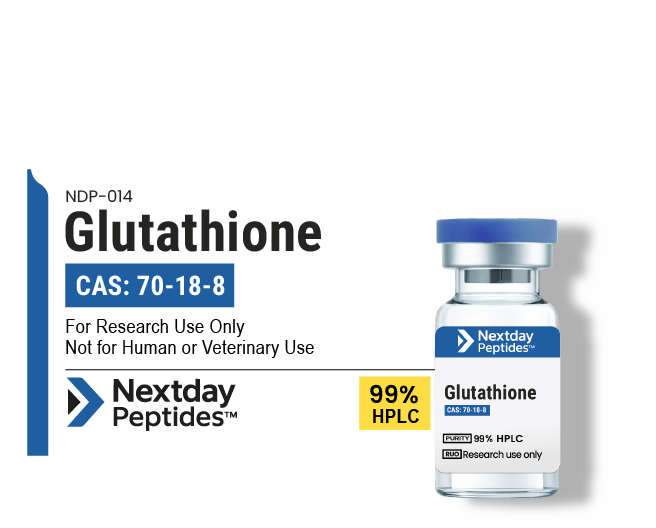
Glutathione GSH (L-Glutathione Reduced, γ-Glutamylcysteinylglycine, CAS 70-18-8) is an endogenous tripeptide composed of glutamic acid, cysteine, and glycine — the most abundant non-protein thiol found in virtually all living cells — supplied by Nextday Peptides in lyophilized powder format for laboratory and analytical research applications. As the predominant intracellular antioxidant and a central mediator of cellular redox homeostasis, GSH is one of the most extensively studied compounds in cellular biology with thousands of published references across oxidative stress, detoxification, redox signaling, and protein biochemistry research. Each vial is independently verified to ≥99% HPLC purity with a Certificate of Analysis available on request. For scientific research use only.
Compound Specifications
| Compound Name | L-Glutathione Reduced / GSH / γ-Glutamylcysteinylglycine |
| IUPAC Name | (2S)-2-amino-5-[[(2R)-1-(carboxymethylamino)-1-oxo-3-sulfanylpropan-2-yl]amino]-5-oxopentanoic acid |
| Components | Glutamic Acid + Cysteine + Glycine (tripeptide) |
| Molecular Formula | C₁₀H₁₇N₃O₆S |
| Molecular Weight | 307.32 g/mol |
| PubChem CID | 124886 |
| CAS Number | 70-18-8 |
| Form | Lyophilized powder |
| Appearance | White crystalline powder |
| Purity | ≥99% (HPLC verified) |
| Solubility | Freely soluble in water; insoluble in methanol and diethyl ether |
| Storage | -20°C; protect from air, light, and moisture — air sensitive compound |
| Synonyms | GSH, Glutathione-SH, γ-L-Glutamyl-L-cysteinyl-glycine, Reduced Glutathione |
Why Research Laboratories Select Glutathione GSH
Glutathione is the most abundant non-protein thiol in mammalian cells and one of the most fundamental reference compounds in cellular biology research. Its central role in maintaining cellular redox homeostasis — alternating between its reduced (GSH) and oxidized (GSSG) forms — makes it an essential tool for laboratories investigating oxidative stress models, reactive oxygen species (ROS) scavenging, thiol-dependent enzyme activity, glutathione S-transferase (GST) tag protein purification, and detoxification pathway biology.
- Most abundant non-protein thiol in mammalian cells — present at 1–10 mM in most cell types
- Primary endogenous antioxidant — scavenges reactive oxygen species and reactive nitrogen species in cellular research models
- GSH/GSSG ratio widely used as a biomarker of cellular oxidative stress in preclinical research models
- Essential cofactor for glutathione S-transferase (GST) — used extensively in GST-tag protein affinity purification
- Studied in xenobiotic detoxification, drug conjugation, and toxicology research models
- Referenced across thousands of peer-reviewed publications at Sigma-Aldrich, Abcam, Santa Cruz Biotechnology, and Selleckchem
- Freely soluble in water — easy to prepare aqueous research solutions at physiologically relevant concentrations
- Batch and lot identifiers on all labeling for full laboratory documentation compliance
Research Background
Glutathione was first identified by Hopkins in 1921 and its tripeptide structure established by Kendall et al. in 1929. It has since become one of the most studied compounds in cellular biology with thousands of published references. Pompella et al. (2003) published a comprehensive review in Biochemical Pharmacology on glutathione’s multiple cellular roles. Pastore et al. (2003) in Clinica Chimica Acta reviewed GSH analysis and its implications in redox and detoxification research. The GSH/GSSG ratio is a standard measurement in oxidative stress research models. All information provided here is for educational and reference purposes only and does not constitute medical or clinical guidance.
Reference sources: PubChem — Glutathione (CID 124886) | Sigma-Aldrich — L-Glutathione Reduced (G4251)
Shipping & Fulfillment
- Ships from U.S. warehouses — Florida, North Carolina, and California
- Overnight and 2-day shipping available at checkout
- Same-day processing on orders placed before 3:30 PM ET
- Discreet packaging with full tracking provided
- Bulk research orders welcome — contact us for volume pricing
Storage & Handling
- Store lyophilized powder at -20°C away from light, air, and moisture
- GSH is air sensitive — minimize exposure to oxygen during handling and reseal immediately after each use
- Prepare aqueous solutions fresh and use promptly — dissolved GSH oxidizes over time
- For longer-term solution storage prepare in degassed water and store under inert gas at -80°C
- Handle using appropriate laboratory safety protocols
- Keep containers tightly sealed and desiccated when not in use
Frequently Asked Questions
What is Glutathione GSH?
Glutathione (L-Glutathione Reduced, CAS 70-18-8) is an endogenous tripeptide composed of glutamic acid, cysteine, and glycine. It is the most abundant non-protein thiol in mammalian cells and the primary intracellular antioxidant. Supplied strictly for scientific, analytical, and in-vitro laboratory research use only.
What is the difference between GSH and GSSG?
GSH is the reduced (active) form of glutathione containing a free thiol group. GSSG is the oxidized form — two GSH molecules joined by a disulfide bond. The GSH/GSSG ratio is a standard measure of cellular redox state in laboratory research, with a lower ratio indicating higher oxidative stress. This product is the reduced GSH form.
Why is Glutathione used in GST-tag protein purification?
Glutathione S-transferase (GST) binds sp