
Gonadorelin Research Peptide (GnRH / LHRH)
Free Base Form • Lyophilized Format • ≥99% HPLC Purity • Ships in 1–2 Business Days • U.S. Warehouses
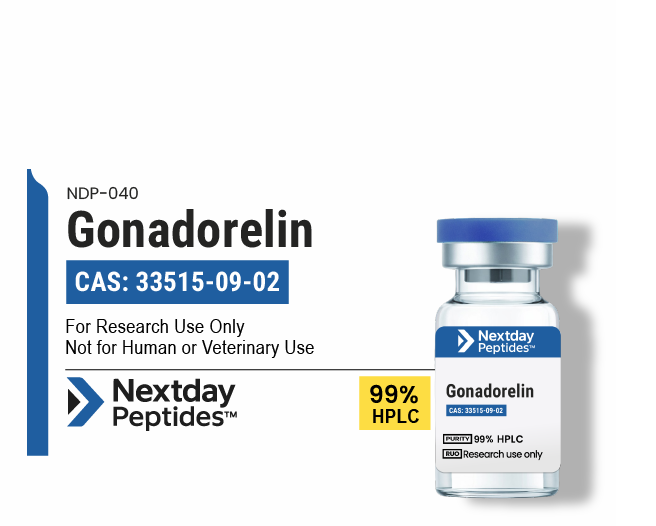
Gonadorelin (GnRH, LHRH, CAS 33515-09-2) is a synthetic decapeptide with the sequence pGlu-His-Trp-Ser-Tyr-Gly-Leu-Arg-Pro-Gly-NH₂ — identical in structure to endogenous gonadotropin-releasing hormone produced by hypothalamic neurons — supplied by Nextday Peptides in free base lyophilized format for laboratory and analytical research applications. As the primary hypothalamic regulator of the pituitary-gonadal axis, Gonadorelin activates GnRH receptors (GnRHR) on anterior pituitary gonadotroph cells via Gq/11-mediated phospholipase C signaling, making it an essential reference compound for laboratories investigating HPG axis biology, GnRHR pharmacology, gonadotropin signaling cascades, and pulsatile endocrine feedback dynamics. Each vial is independently verified to ≥99% HPLC purity with a Certificate of Analysis available on request. For scientific research use only.
Compound Specifications
| Compound Name | Gonadorelin / GnRH / LHRH / Gonadotropin-Releasing Hormone |
| Peptide Sequence | pGlu-His-Trp-Ser-Tyr-Gly-Leu-Arg-Pro-Gly-NH₂ |
| Amino Acids | 10 (Decapeptide) — N-terminal pyroglutamate, C-terminal amide |
| Salt Form | Free base (no acetate) |
| Receptor Target | GnRHR (GnRH Receptor) — class A GPCR on pituitary gonadotrophs |
| Molecular Formula | C₅₅H₇₅N₁₇O₁₃ |
| Molecular Weight | 1,182.31 g/mol |
| PubChem CID | 638793 |
| CAS Number | 33515-09-2 (free base) |
| Form | Lyophilized powder |
| Appearance | White to off-white powder |
| Purity | ≥99% (HPLC verified) |
| Storage | -20°C lyophilized; 2–8°C after reconstitution (use within 14 days) |
| Synonyms | GnRH, LHRH, Luliberin, Gonadorelin, Gonadoliberin, GnRH-I |
Why Research Laboratories Select Gonadorelin
Gonadorelin is the foundational reference compound for hypothalamic-pituitary-gonadal (HPG) axis research — the endogenous decapeptide against which all synthetic GnRH analogs and antagonists are pharmacologically characterized. Its well-defined GnRHR activation profile, Gq/11-mediated signaling cascade, and pulsatile secretion biology make it indispensable for laboratories investigating GnRH receptor pharmacology, gonadotropin (LH/FSH) secretion dynamics, pituitary responsiveness models, and comparative GnRH analog structure-activity relationship research.
- Endogenous GnRH sequence — identical to native hypothalamic decapeptide, N-terminal pyroglutamate and C-terminal amide intact
- Free base form — no acetate counterion for experiments requiring precise concentration control
- GnRHR full agonist — activates Gq/11/PLC pathway in pituitary gonadotrophs with downstream IP3/DAG/Ca²⁺ second messenger signaling
- MAPK/ERK pathway downstream — studied in transcriptional regulation of LH and FSH subunit gene expression research
- FDA-approved pharmaceutical equivalent (Factrel/Lutrepulse) — extensive published clinical and preclinical literature for reference
- Studied in pulsatile versus continuous GnRHR stimulation research — pulsatile stimulation studied for gonadotropin release, continuous stimulation studied for receptor desensitization
- Reference compound for Kisspeptin-10, Triptorelin, Leuprolide, and other GnRH system research tools
- Lyophilized format ensures stability and reproducibility across experimental runs
Research Background
GnRH was first isolated and characterized by Andrew Schally and Roger Guillemin — work for which they shared the Nobel Prize in Physiology or Medicine in 1977. Gonadorelin has since been studied in thousands of published preclinical and clinical research papers across reproductive biology, endocrinology, and neuroendocrinology. The pharmaceutical form (Factrel/Lutrepulse) has FDA approval as a diagnostic agent and for ovulation induction. Research-grade Gonadorelin supplied by Nextday Peptides is not equivalent to any approved pharmaceutical formulation. All information provided here is for educational and reference purposes only and does not constitute medical or clinical guidance.
Reference sources: PubChem — Gonadorelin (CID 638793) | NIH StatPearls — Gonadorelin
Shipping & Fulfillment
- Ships from U.S. warehouses — Florida, North Carolina, and California
- Overnight and 2-day shipping available at checkout
- Same-day processing on orders placed before 3:30 PM ET
- Discreet packaging with full tracking provided
- Bulk research orders welcome — contact us for volume pricing
Storage & Handling
- Store lyophilized peptide at -20°C desiccated away from light and moisture
- After reconstitution store at 2–8°C and use within 14 days
- Reconstitute in sterile 18MΩ water at ≥100 µg/mL — can then be further diluted in aqueous buffers
- Avoid vigorous agitation during and after reconstitution to prevent aggregation
- Avoid repeated freeze-thaw cycles to maintain peptide integrity
- Handle using appropriate laboratory safety protocols
Frequently Asked Questions
What is Gonadorelin?
Gonadorelin (GnRH, CAS 33515-09-2) is a synthetic decapeptide identical in sequence to endogenous gonadotropin-releasing hormone — the primary hypothalamic regulator of the pituitary-gonadal axis. It activates GnRH receptors on pituitary gonadotrophs triggering LH and FSH signaling cascades. Supplied in free base form — no acetate. Supplied strictly for scientific, analytical, and in-vitro laboratory research use only.
What is the difference between the free base and acetate forms of Gonadorelin?
Gonadorelin free base (CAS 33515-09-2) contains no acetate counterion. Gonadorelin acetate (CAS 71447-49-9) is the acetate salt form. For most laboratory research applications the two are functionally equivalent — but the free base form is preferred when precise concentration control is required, since the acetate counterion adds molecular weight (~60 g/mol per acetate) that must be accounted for in stock solution preparation. This product is the free base form.
How does pulsatile versus continuous GnRHR stimulation differ in research models?
In experimental models pulsatile GnRH stimulation — mimicking the natural 60–90 minute secretion pulses of endogenous GnRH — maintains GnRHR sensitivity and stimulates gonadotropin release. Continuous GnRHR stimulation causes receptor downregulation and desensitization — suppressing rather than stimulating gonadotropin secretion. Both phenomena are studied in laboratory research using Gonadorelin at varying administration protocols.
How does Gonadorelin relate to Kisspeptin-10?
Kisspeptin-10 acts upstream of Gonadorelin — kisspeptin neurons in the hypothalamus activate GnRH neurons via KISS1R/GPR54 signaling, triggering GnRH (Gonadorelin) release. Gonadorelin then acts on pituitary gonadotrophs. Laboratories studying the complete HPG axis signaling cascade frequently use both Kisspeptin-10 and Gonadorelin as complementary research tools.
What purity is your Gonadorelin?
Every batch is independently verified to ≥99% HPLC purity. A Certificate of Analysis is available for each lot.
How fast does Nextday Peptides ship?
We ship from U.S. warehouses in Florida, North Carolina, and California. Overnight and 2-day shipping options are available. Orders placed before 3:30 PM ET are processed same day.
Are bulk orders available?
Yes. We accommodate bulk research orders. Contact us directly for volume pricing and availability.
Is this product approved for medical use?
Research-grade Gonadorelin is not equivalent to any approved pharmaceutical formulation. It is for laboratory research use only and is not intended for diagnostic, therapeutic, or clinical applications.
What other compounds does Nextday Peptides carry?
We also carry Kisspeptin-10, Sermorelin, Ipamorelin, and Thymosin Alpha-1. View our full research compounds catalog.
For Research Use Only — Not for human or veterinary consumption • Not equivalent to any approved drug product • Supplied by Nextday Peptides for controlled in-vitro laboratory research use only