
Semaglutide Research Peptide (GLP1-S)
Lyophilized Format • ≥99% HPLC Purity • Ships in 1–2 Business Days • U.S. Warehouses
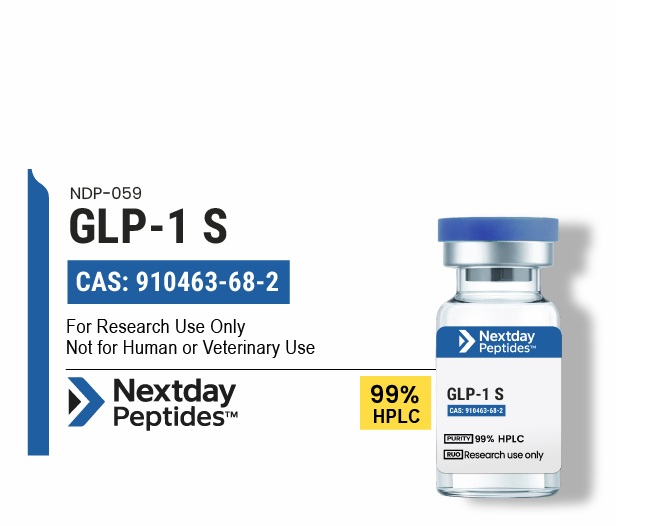
Semaglutide (GLP1-S), also designated NN9535, is a synthetic 31 amino acid GLP-1 receptor agonist analog supplied by Nextday Peptides for laboratory and analytical research applications. Structurally modified from native GLP-1 with amino acid substitutions and a C-18 fatty acid chain that enhances albumin binding and stability, Semaglutide is one of the most extensively referenced incretin analogs in current metabolic research. Each vial is independently verified to ≥99% HPLC purity with a Certificate of Analysis available on request. For scientific research use only.
Compound Specifications
| Compound Name | Semaglutide / GLP1-S / NN9535 |
| Receptor Target | GLP-1 Receptor (GLP-1R) |
| Amino Acids | 31 |
| Molecular Formula | C₁₈₇H₂₉₁N₄₅O₅₉ |
| Molecular Weight | 4,113.6 g/mol |
| Form | Lyophilized powder |
| Appearance | White to off-white powder |
| Purity | ≥99% (HPLC verified) |
| Storage | -20°C lyophilized; 2–8°C after reconstitution |
| CAS Number | 910463-68-2 |
| Synonym | NN9535 |
| SKU | NDP-058 |
Mechanism of Action
Semaglutide is a GLP-1 receptor agonist analog with two key structural modifications from native GLP-1: a substitution at position 8 that protects against DPP-4 enzymatic degradation, and a C-18 fatty diacid chain attached via a linker that enables reversible albumin binding. These modifications extend its half-life significantly compared to native GLP-1 in research models.
- GLP-1 receptor activation — stimulates glucose-dependent insulin secretion from pancreatic beta cells, suppresses glucagon release from alpha cells, and slows gastric emptying in research models
- cAMP-mediated signaling — GLP-1R activation increases intracellular cAMP, activating PKA and EPAC pathways that regulate insulin gene expression and beta cell survival in preclinical studies
- Central nervous system effects — GLP-1 receptors are expressed in hypothalamic regions involved in appetite regulation; receptor activation in these areas is studied in energy homeostasis research
- Albumin binding via C-18 chain — the fatty acid modification enables non-covalent albumin binding, protecting the peptide from renal clearance and extending its research utility in pharmacokinetic studies
As a single GLP-1 receptor agonist, semaglutide is the standard reference compound for GLP-1R biology research, enabling direct comparison with dual agonists (tirzepatide) and triple agonists (retatrutide) to isolate GLP-1 receptor-specific effects.
Research Applications
Semaglutide is studied across several active research domains:
- GLP-1 receptor binding kinetics, agonist potency, and receptor desensitization studies
- cAMP signaling cascade and downstream PKA/EPAC pathway investigation
- Comparative incretin pharmacology — isolating GLP-1R effects vs dual and triple agonists
- Pancreatic beta cell function, insulin secretion, and glucose-stimulated insulin response
- Hypothalamic appetite regulation and energy expenditure modeling
- Fatty acid modification and albumin binding pharmacokinetic research
- GLP-1R expression profiling across tissue types in preclinical models
- Incretin effect studies comparing native GLP-1 vs structural analogs
Why Research Laboratories Select GLP1-S
Semaglutide is among the most studied GLP-1 receptor agonist analogs in current metabolic and endocrine research. Its structural modifications — including two amino acid substitutions compared to native GLP-1 and a C-18 fatty acid chain — give it enhanced stability and albumin binding properties, making it a valuable reference compound for laboratories studying sustained GLP-1 receptor activation, incretin signaling dynamics, and comparative receptor biology.
- 31 amino acid GLP-1 analog with C-18 fatty acid chain for enhanced stability in experimental settings
- Single receptor target — GLP-1R — useful for comparative studies against dual and triple agonists
- Extensively referenced in peer-reviewed literature on incretin biology and metabolic signaling
- Widely used as a reference compound in studies comparing GLP-1 class analogs
- Lyophilized format ensures stability and reproducibility across experimental runs
- Batch and lot identifiers on all labeling for full laboratory documentation compliance
Semaglutide vs. Tirzepatide vs. Retatrutide: Research Comparison
| Compound | Receptor Targets | Agonist Type | Structural Feature |
| Semaglutide (GLP1-S) | GLP-1R | Single agonist | C-18 fatty diacid, albumin binding |
| Tirzepatide | GLP-1R, GIPR | Dual agonist | C-20 fatty diacid, albumin binding |
| Retatrutide | GLP-1R, GIPR, GCGR | Triple agonist | C-18 fatty diacid, albumin binding |
This comparison table is provided for research reference only. All compounds listed are supplied for laboratory research use only and are not intended for human use.
Research Background
Semaglutide was first described in scientific literature in 2015 by Lau et al. in the Journal of Medicinal Chemistry. As a GLP-1 receptor agonist analog, it has been studied extensively in preclinical models examining GLP-1 receptor binding dynamics, cAMP-mediated signaling cascades, and comparative incretin pathway biology. Phase 3 clinical trials (SUSTAIN series) have been completed and published in peer-reviewed journals. All information provided here is for educational and reference purposes only and does not constitute medical or clinical guidance.
Reference sources: PubChem — Semaglutide | NEJM — SUSTAIN-6 Trial
Shipping & Fulfillment
- Ships from U.S. warehouses — Florida, North Carolina, and California
- Overnight and 2-day shipping available at checkout
- Same-day processing on orders placed before cutoff
- Discreet packaging with full tracking provided
- Bulk research orders welcome — contact us for volume pricing
Storage & Handling
- Store lyophilized peptide at -20°C away from light and moisture
- After reconstitution, store at 2–8°C and use promptly
- Avoid repeated freeze-thaw cycles to maintain integrity
- Handle using appropriate laboratory safety protocols
- Keep containers sealed when not in use
Frequently Asked Questions
What is Semaglutide GLP1-S?
Semaglutide (NN9535) is a synthetic 31 amino acid GLP-1 receptor agonist analog with structural modifications that enhance its stability compared to native GLP-1. It is supplied strictly for scientific, analytical, and in-vitro laboratory research use only.
How does semaglutide differ from native GLP-1?
Native GLP-1 has a very short half-life due to rapid DPP-4 enzymatic degradation. Semaglutide has two structural modifications — a position 8 amino acid substitution and a C-18 fatty acid chain — that protect it from degradation and enable albumin binding, significantly extending its active duration in research models.
How does Semaglutide differ from Tirzepatide and Retatrutide?
Semaglutide targets only the GLP-1 receptor, making it a single receptor agonist. Tirzepatide targets both GIP and GLP-1 receptors (dual agonist). Retatrutide targets GLP-1, GIP, and glucagon receptors (triple agonist). This makes semaglutide the standard reference compound for isolating GLP-1 receptor-specific effects in comparative research.
What purity is your Semaglutide?
Every batch is independently verified to ≥99% HPLC purity. A Certificate of Analysis is available for each lot via our COA Library.
How fast does Nextday Peptides ship?
We ship from U.S. warehouses in Florida, North Carolina, and California. Overnight and 2-day shipping options are available. Most orders process same day.
Are bulk orders available?
Yes. We accommodate bulk research orders. Contact us directly for volume pricing and availability.
Is this product approved for medical use?
No. This product is for laboratory research use only. It is not approved for human or veterinary use, and is not intended for diagnostic, therapeutic, or clinical applications.
What other compounds does Nextday Peptides carry?
We stock a full range of research peptides including Retatrutide GLP-3, Tirzepatide GLP-2T, BPC-157, and TB-500. View our full research compounds catalog.
For Research Use Only — Not for human or veterinary consumption • Not evaluated by the FDA • Supplied by Nextday Peptides for laboratory research applications only