
FOXO4-DRI Research Peptide (Senolytic / FOXO4-p53 Antagonist)
Lyophilized Format • ≥99% HPLC Purity • Ships in 1–2 Business Days • U.S. Warehouses
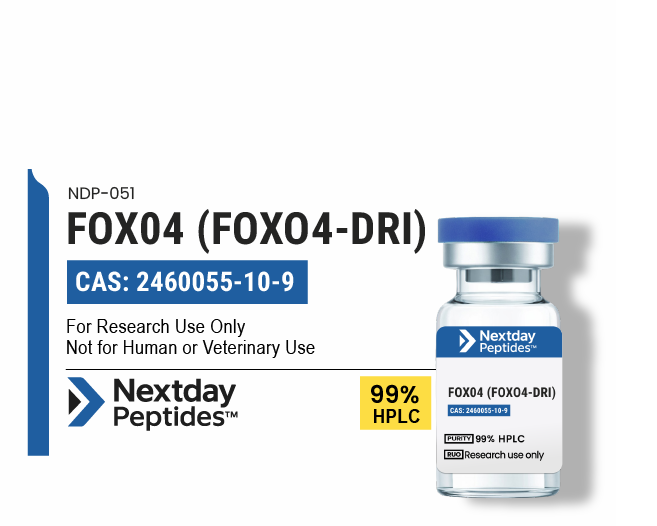
FOXO4-DRI (CAS 2460055-10-9) is a cell-permeable D-retro-inverso (DRI) peptide antagonist of the FOXO4-p53 protein-protein interaction — the first synthetic senolytic peptide designed to selectively induce apoptosis in senescent cells by disrupting the nuclear retention of p53 by FOXO4 — supplied by Nextday Peptides in lyophilized format for laboratory and analytical research applications. The DRI modification — D-amino acid retro-inverso sequence — confers proteolytic resistance while preserving the binding interface geometry required for FOXO4-p53 interaction disruption. Originally characterized by Baar et al. (2017) in Cell, FOXO4-DRI is the primary research tool for investigating FOXO4/p53-dependent senescent cell apoptosis biology in controlled cell culture experimental systems. For scientific research use only.
Compound Specifications
| Compound Name | FOXO4-DRI / FOXO4 D-Retro-Inverso Peptide / FOXO4/p53 Antagonist |
| Classification | Cell-permeable D-retro-inverso senolytic peptide |
| Mechanism | FOXO4-p53 protein-protein interaction antagonist → p53 nuclear exclusion → mitochondrial apoptosis in senescent cells |
| Primary Target | FOXO4/p53 interaction interface |
| Molecular Formula | C₂₂₈H₃₈₈N₈₆O₆₄ |
| Molecular Weight | 5,358.06 g/mol |
| CAS Number | 2460055-10-9 |
| Form | Lyophilized powder |
| Appearance | White to off-white powder |
| Purity | ≥99% (HPLC verified) |
| Storage | -20°C lyophilized; 2–8°C after reconstitution — aliquot to avoid freeze-thaw |
| Synonyms | FOXO4-DRI, FOXO4 DRI peptide, Fork head box O4 D-Retro-Inverso |
Why Research Laboratories Select FOXO4-DRI
FOXO4-DRI is the only synthetic peptide-based senolytic with published in-vivo mouse model data from a peer-reviewed Cell paper — making it the primary reference tool compound for the rapidly expanding field of senolytic biology research. Its unique mechanism — disrupting FOXO4’s nuclear retention of p53 to redirect p53 to mitochondria for caspase-dependent apoptosis selectively in senescent cells — distinguishes it from small-molecule senolytics that act through BCL-2 family inhibition, providing a distinct mechanistic pathway for comparative senolytic research.
- First synthetic senolytic peptide — primary reference tool for FOXO4/p53-dependent senescent cell apoptosis research
- D-retro-inverso modification — all D-amino acids in retro sequence providing proteolytic resistance while preserving binding geometry
- FOXO4-p53 interaction antagonist — disrupts FOXO4 nuclear retention of p53, redirecting p53 to mitochondria
- Selective senescent cell apoptosis — studied for selective killing of senescent fibroblasts, chondrocytes, and Leydig cells versus non-senescent cells in research models
- Baar et al. (2017) Cell paper — landmark publication establishing FOXO4-DRI as senolytic research reference compound
- Studied in chondrocyte, fibroblast, Leydig cell, and cancer-associated fibroblast senescence research models
- Buck Institute for Research on Aging holds patent for senescent/cancer cell targeting application
- Lyophilized format ensures stability and reproducibility across experimental runs
Research Background
FOXO4-DRI was first characterized by Baar et al. (2017) in Cell — a landmark paper demonstrating that disrupting the FOXO4-p53 interaction with a cell-permeable D-retro-inverso peptide selectively induced apoptosis in senescent fibroblasts while sparing non-senescent cells in culture, with subsequent in-vivo mouse model data showing restored fitness markers in naturally aged mice. Zhang et al. (2020) published findings in Aging (Albany NY) on FOXO4-DRI targeting of senescent Leydig cells. Huang et al. (2021) published findings in Frontiers in Bioengineering and Biotechnology on selective removal of senescent chondrocytes from in-vitro expanded human chondrocyte cultures. All information provided here is for educational and reference purposes only and does not constitute medical or clinical guidance.
Reference sources: Baar et al. (2017) — Cell | Huang et al. (2021) — Frontiers in Bioengineering (PMC)
Shipping & Fulfillment
- Ships from U.S. warehouses — Florida, North Carolina, and California
- Overnight and 2-day shipping available at checkout
- Same-day processing on orders placed before 3:30 PM ET
- Discreet packaging with full tracking provided
- Bulk research orders welcome — contact us for volume pricing
Storage & Handling
- Store lyophilized peptide at -20°C away from light and moisture
- After reconstitution aliquot into single-use portions and store at -20°C
- Avoid repeated freeze-thaw cycles — aliquoting is essential for maintaining compound integrity
- Handle using appropriate laboratory safety protocols
- Keep containers sealed when not in use
Frequently Asked Questions
What is FOXO4-DRI?
FOXO4-DRI (CAS 2460055-10-9) is a cell-permeable D-retro-inverso peptide antagonist that blocks the FOXO4-p53 protein-protein interaction. By disrupting FOXO4’s nuclear retention of p53, it redirects p53 to mitochondria triggering caspase-dependent apoptosis selectively in senescent cells. The primary senolytic peptide reference compound in cellular aging research. Supplied strictly for scientific, analytical, and in-vitro laboratory research use only.
What is D-retro-inverso (DRI) peptide design?
A D-retro-inverso peptide is constructed by reversing the amino acid sequence and replacing all L-amino acids with D-amino acid stereoisomers. This modification produces a peptide with identical side-chain topology to the original L-amino acid sequence at the protein binding interface — preserving binding geometry — while conferring near-complete resistance to proteolytic degradation by proteases that act on L-amino acid peptide bonds. The DRI modification is what makes FOXO4-DRI cell-permeable and proteolytically stable in experimental systems.
How does FOXO4-DRI selectively target senescent cells?
In non-senescent cells FOXO4 and p53 do not interact significantly and p53 is available for normal tumor suppressor function. In senescent cells FOXO4 actively sequesters p53 in the nucleus — preventing p53-driven apoptosis and allowing senescent cells to persist. FOXO4-DRI disrupts this nuclear retention interaction, releasing p53 to translocate to mitochondria where it initiates caspase-dependent apoptosis specifically in the senescent cell population.
What cell types has FOXO4-DRI been studied in?
In published preclinical research FOXO4-DRI has been studied in senescent fibroblast cultures (Baar et al. 2017 — Cell), senescent chondrocytes from in-vitro expanded human chondrocyte cultures (Huang et al. 2021), senescent Leydig cells in aged mouse models (Zhang et al. 2020), and senescence-like cancer-associated fibroblasts in NSCLC radiation research models. All findings are from controlled preclinical research settings.
What purity is your FOXO4-DRI?
Every batch is independently verified to ≥99% HPLC purity. A Certificate of Analysis is available for each lot.
How fast does Nextday Peptides ship?
We ship from U.S. warehouses in Florida, North Carolina, and California. Overnight and 2-day shipping options are available. Orders placed before 3:30 PM ET are processed same day.
Are bulk orders available?
Yes. We accommodate bulk research orders. Contact us directly for volume pricing and availability.
Is this product approved for medical use?
No. This product is for laboratory research use only. It is not approved for human or veterinary use, and is not intended for diagnostic, therapeutic, or clinical applications of any kind.
What other compounds does Nextday Peptides carry?
We also carry Epitalon, Thymosin Alpha-1, MOTS-C, and NAD+. View our full research compounds catalog.
For Research Use Only — Not for human or veterinary consumption • Not evaluated by the FDA • Supplied by Nextday Peptides for controlled in-vitro laboratory research use only